
What Is a Good ROAS? It Depends on Your Margin
Every advertiser asks what a good ROAS is, and most answers quote one number. The honest answer has two parts: the ROAS you need to break even, which comes from your margin, and what other stores in your industry actually get, which tells you how hard that is.
Updated
The short answer
A good ROAS is any ROAS above your break-even ROAS, which is 1 ÷ your profit margin before ads: 2.0 with a 50% margin, 3.33 with 30%, 4.0 with 25%. A ROAS of 3 is excellent for one store and a loss for another.
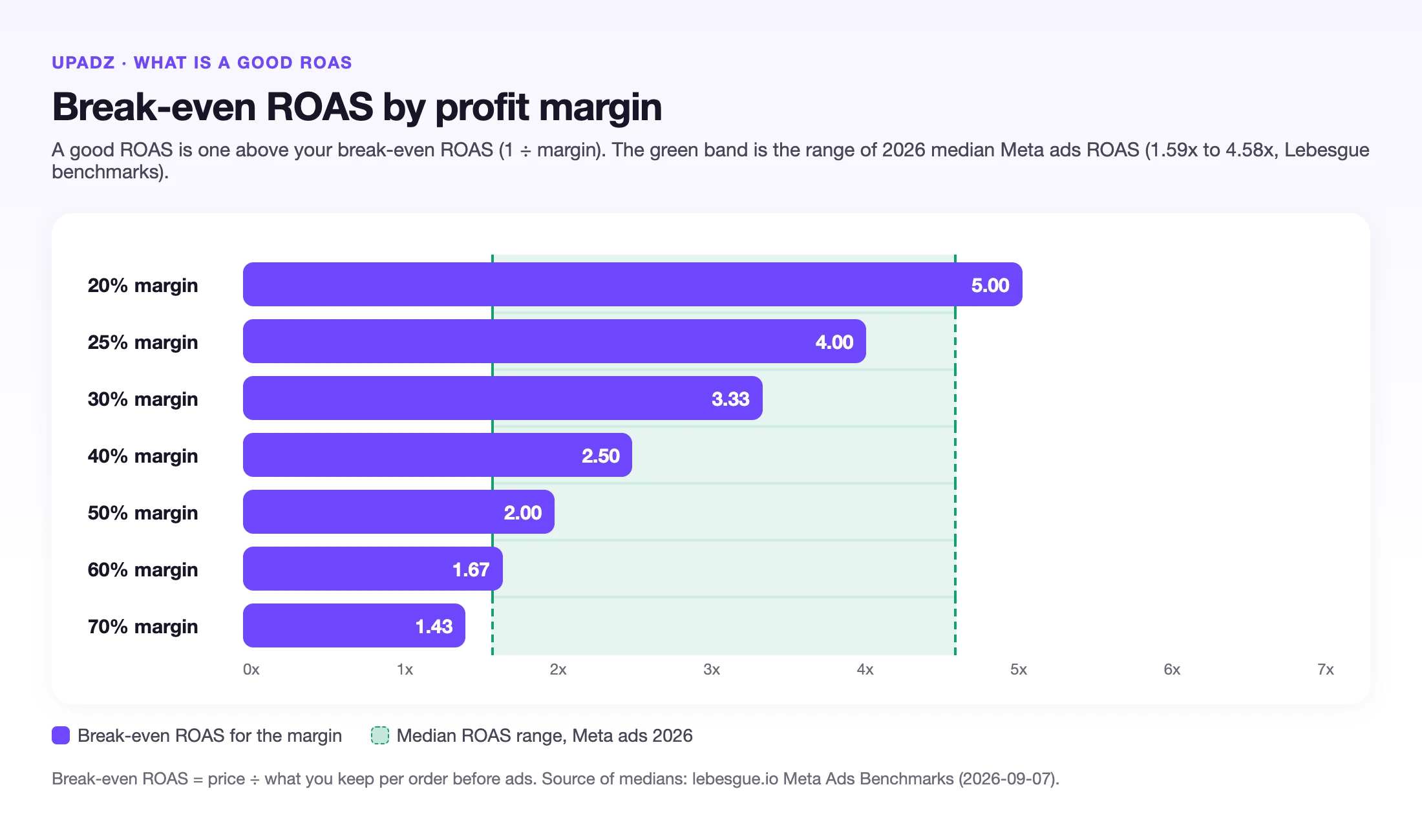
For reference, the 2026 median ROAS on Meta ads runs from about 1.6x to 4.6x depending on the industry and the order value (Lebesgue benchmarks): close to the break-even ROAS of a store with a 25% to 60% margin.
Median Meta ads ROAS by industry and order value (2026)
| Criteria | Orders under $50 | $50–$100 | $100–$200 | $200 and up |
|---|---|---|---|---|
| Beauty & wellness | 1.78x | 1.67x | 2.44x | 1.63x |
| Electronics & gaming | 1.98x | 2.67x | 3.25x | 2.76x |
| Fashion | 2.20x | 3.48x | 3.63x | 2.68x |
| Fitness & outdoors | 1.88x | 2.60x | 3.12x | 3.17x |
| Food, beverage & pet | 2.00x | 2.95x | 1.82x | 2.76x |
| Home & lifestyle | 2.06x | 2.91x | 4.17x | 4.58x |
| Jewelry & accessories | 1.88x | 2.82x | 3.49x | 1.83x |
| Services & other | 1.59x | 2.56x | 3.92x | 2.86x |
1. Your order
What the customer pays for one order
What the product costs you
What you pay to deliver the order
As a percentage of the price
2. Your campaign (optional)
Sales the ads brought in, e.g. Meta's purchase value
What you paid for those ads
Break-even ROAS
1.96
Below this ROAS your ads lose money. Above it, they are profitable.
- You keep per order, before ads
- $25.50 (51%)
- Break-even CPA: most you can pay per order
- $25.50
Your campaign ROAS
3.00 (300%)
Above break-even: about $530.00 profit after ads.
Break-even ROAS against the 2026 median
Start from your break-even ROAS
Break-even ROAS is the ROAS at which your ads pay for themselves and nothing more. It equals your selling price divided by what you keep from one order before ads, or more simply 1 ÷ your margin. At a 20% margin you need a ROAS of 5.0 to break even; at 40%, 2.5; at 60%, 1.67; at 70%, 1.43.
Work it out per product, not for the whole store. A $30 gadget that keeps $9 breaks even at 3.33, while a $90 bundle that keeps $45 breaks even at 2.0. The same campaign ROAS of 2.5 loses money on the first and makes money on the second. The calculator above does the arithmetic for you.
What is a good ROAS for ecommerce in 2026?
Lebesgue's 2026 Meta ads benchmarks put the median ROAS between 1.59x and 4.58x across eight industries and four order-value bands. Half of the stores in each group do worse than the median, so a ROAS of 2 is ordinary, not weak. The benchmark does not publish its sample size, so treat it as a rough guide, not a target.
Put the two numbers side by side for your own margin. If you sell beauty products under $50 with a 50% margin, you break even at 2.0, above that group's median of 1.78x: a median result would lose a little on the first order. If you sell home products over $200 with a 40% margin, you break even at 2.5, well below that group's 4.58x median. The benchmark does not publish the margins of the stores behind it, so it cannot tell you whether they are profitable.
Average ROAS rises with order value, up to a point
In five of the eight industries the median ROAS is lowest for orders under $50, and in five it peaks between $100 and $200. A bigger basket makes each conversion worth more while clicks cost about the same. Above $200 it depends on the category: home and fitness keep climbing, while beauty, jewelry and fashion fall back. Food, beverage and pet is the exception, with its lowest median between $100 and $200.
That makes order value worth testing. Bundles, multi-packs and free-shipping thresholds can raise the average order value; test them and recalculate the margin after their extra cost, because a higher ROAS only helps if the margin holds.
Platform ROAS vs real ROAS
The ROAS in Meta Ads Manager or Google Ads is the revenue the platform attributes to itself, within its attribution window. Several platforms can claim the same sale, so the sum of platform ROAS is often higher than reality.
Check it against your blended ROAS, sometimes called MER: total store revenue ÷ total ad spend for the same period. If platform ROAS says 3.0 but blended ROAS is 1.8, judge profit on the 1.8 and use the platform numbers only to compare campaigns with each other.
When a ROAS below break-even is still good
Break-even ROAS assumes the customer buys once. If customers come back, the first order can be bought at a loss and repaid later. A store whose customers buy twice a year, without new ads, can accept a first-order ROAS below break-even, as long as it knows the repeat rate from its own data, not from hope.
The same applies to launches and creative tests: a test is buying information, not profit. Set a budget for it, read the result, and only judge ROAS once you scale the ad that won.
How to raise your ROAS
ROAS has three inputs: what a click costs, how many clicks buy, and how much each buyer spends. The click cost on paid social is driven mostly by the creative: an ad people stop for gets cheaper attention. Conversion depends on the product page and the offer. Spend per buyer depends on pricing, bundles and upsells.
Creative is the quickest of the three to change. Test several hooks and angles for the same product, keep the ad that beats your break-even ROAS, and replace it before it fatigues.
Five checks before you call a ROAS good
- Compare it with the product's break-even ROAS, not the account average
- Use the same date range for revenue and ad spend
- Check platform ROAS against blended ROAS (MER)
- Count returns and refunds, which lower the revenue you keep
- Judge a test on what it taught you, a scaled ad on profit
How Upadz helps you beat break-even
The fastest way to raise ROAS is to find a better ad. Upadz starts from a product URL, proposes 3 ad concepts with different hooks and angles, and turns the one you pick into a finished video ad or static ads, so you can test several ideas against your break-even ROAS instead of betting on one.
Keep reading
Frequently asked questions
What is a good ROAS?
Any ROAS above your break-even ROAS, which is 1 ÷ your profit margin before ads. With a 50% margin that is anything above 2.0; with a 25% margin, anything above 4.0.
What is an average ROAS?
On Meta ads, Lebesgue's 2026 benchmarks put the median between 1.59x and 4.58x, depending on the industry and order value. An average only tells you how hard it is; your margin tells you whether it is profitable.
Is a ROAS of 2 good?
It is good if your margin is above 50%, because your break-even ROAS is then below 2.0. With a 40% margin, a ROAS of 2 loses money: you need 2.5 to break even.
Is a ROAS of 4 good?
A ROAS of 4 is profitable when your margin before ads is above 25%, before fixed costs. At exactly 25% it is break-even, and below 25% it loses money.
What is a good ROAS for Facebook ads?
The same rule applies: above your break-even ROAS. As a reference, the 2026 median Meta ads ROAS for orders under $50 ranges from 1.59x to 2.20x across industries, and is higher for orders between $100 and $200 in most of them.
What is the difference between ROAS and MER?
ROAS usually means the revenue one platform attributes to its ads, divided by its ad spend. MER, or blended ROAS, is total store revenue divided by total ad spend, which avoids double counting between platforms.
Facts checked on against Lebesgue, Meta Ads Benchmarks by industry and AOV (2026-09-07). Prices and features change; tell us if something is out of date.
Find the ad that beats break-even
Paste a product URL, compare 3 ad concepts and test the hooks before you scale.
Start free