
ROAS Calculator
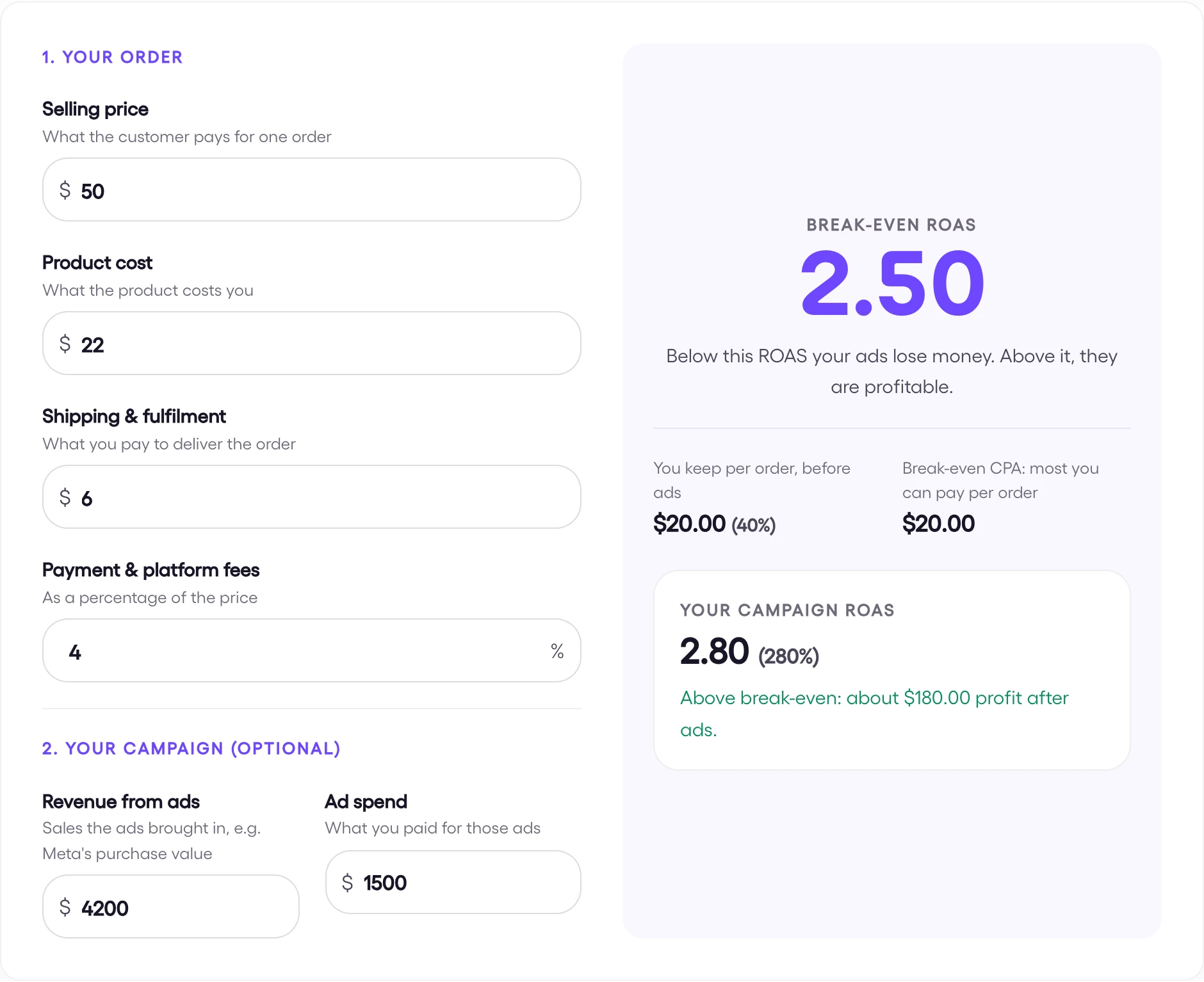
A simple ROAS calculator for paid ads. Enter what an order earns and costs you to get your break-even ROAS and break-even CPA. Add your ad revenue and spend to see your campaign's ROAS and whether it makes money.
Updated
1. Your order
What the customer pays for one order
What the product costs you
What you pay to deliver the order
As a percentage of the price
2. Your campaign (optional)
Sales the ads brought in, e.g. Meta's purchase value
What you paid for those ads
Break-even ROAS
1.96
Below this ROAS your ads lose money. Above it, they are profitable.
- You keep per order, before ads
- $25.50 (51%)
- Break-even CPA: most you can pay per order
- $25.50
Your campaign ROAS
3.00 (300%)
Above break-even: about $530.00 profit after ads.
What the number means
This ROAS calculator divides the revenue your ads bring in by what you spent on them (ROAS, return on ad spend): $3,000 of sales from $1,000 of ads is a ROAS of 3.0, or 300%. Whether that is profitable depends on your break-even ROAS, which is 1 divided by your profit margin before ads: 2.5 with a 40% margin, 4.0 with a 25% margin.
Your break-even CPA comes from the same margin: if you keep $20 from a $50 order before ads, you can spend up to $20 to win that order. Above your break-even ROAS your ads make money; below it they lose money, however good the number looks.
Break-even ROAS by profit margin
| Criteria | Break-even ROAS | Ad spend that breaks even on a $100 order |
|---|---|---|
| 15% margin | 6.67 | $15 |
| 20% margin | 5.00 | $20 |
| 25% margin | 4.00 | $25 |
| 30% margin | 3.33 | $30 |
| 35% margin | 2.86 | $35 |
| 40% margin | 2.50 | $40 |
| 50% margin | 2.00 | $50 |
| 60% margin | 1.67 | $60 |
| 70% margin | 1.43 | $70 |
| 80% margin | 1.25 | $80 |
How to calculate ROAS
The ROAS formula is: ROAS = revenue from ads ÷ ad spend. If a campaign cost $1,000 and brought in $3,000 of sales, its ROAS is 3,000 ÷ 1,000 = 3.0. That is often written 3:1 or 300%: each dollar of ads returned three dollars of revenue. ROAS is a ratio, and the percentage is the same number multiplied by 100.
Use the revenue the ads produced, not your total sales, and the same date range for both numbers. In Meta Ads Manager, look at Purchase ROAS (return on ad spend); in Google Ads, look at Conv. value / cost, after checking that your conversion values are sales. To calculate ROAS in Excel or Google Sheets, put revenue in B2 and ad spend in C2 and write =B2/C2.
ROAS can be zero, when ads bring no sales, but never negative: revenue and spend are never below zero. What can be negative is your profit after ads, which is why the ROAS calculator above compares your ROAS with your break-even ROAS.
Calculate ROAS step by step: 3 worked examples
Dropshipping store, 30% margin. A $40 product leaves $12 after the product, shipping and fees, so the break-even ROAS is 40 ÷ 12 = 3.33. The campaign spent $600 and brought in $1,800: a ROAS of 3.0. It looks healthy, but it is below 3.33, and the store lost money: 30% of $1,800 is $540 kept, minus $600 of ads, is −$60.
DTC brand, 60% margin. The break-even ROAS is 1 ÷ 0.60 = 1.67. The campaign spent $1,000 and brought in $2,400: a ROAS of 2.4. That is above 1.67, so it is profitable: 60% of $2,400 is $1,440 kept, minus $1,000 of ads, is $440 of profit.
Agency client, two campaigns, 40% margin. Campaign A spent $2,000 for $7,000 of sales (ROAS 3.5); campaign B spent $1,000 for $2,000 (ROAS 2.0). Together that is $9,000 from $3,000, a blended ROAS of 3.0, above the 2.5 break-even. But campaign B alone keeps $800 for $1,000 of ads and loses $200: calculate ROAS per campaign and per product, not only for the whole account.
The break-even ROAS formula
Break-even ROAS = price ÷ (price − product cost − shipping − fees). The bottom of that fraction is what you keep from one order before paying for the ad that produced it. As a shortcut, break-even ROAS = 1 ÷ profit margin before ads.
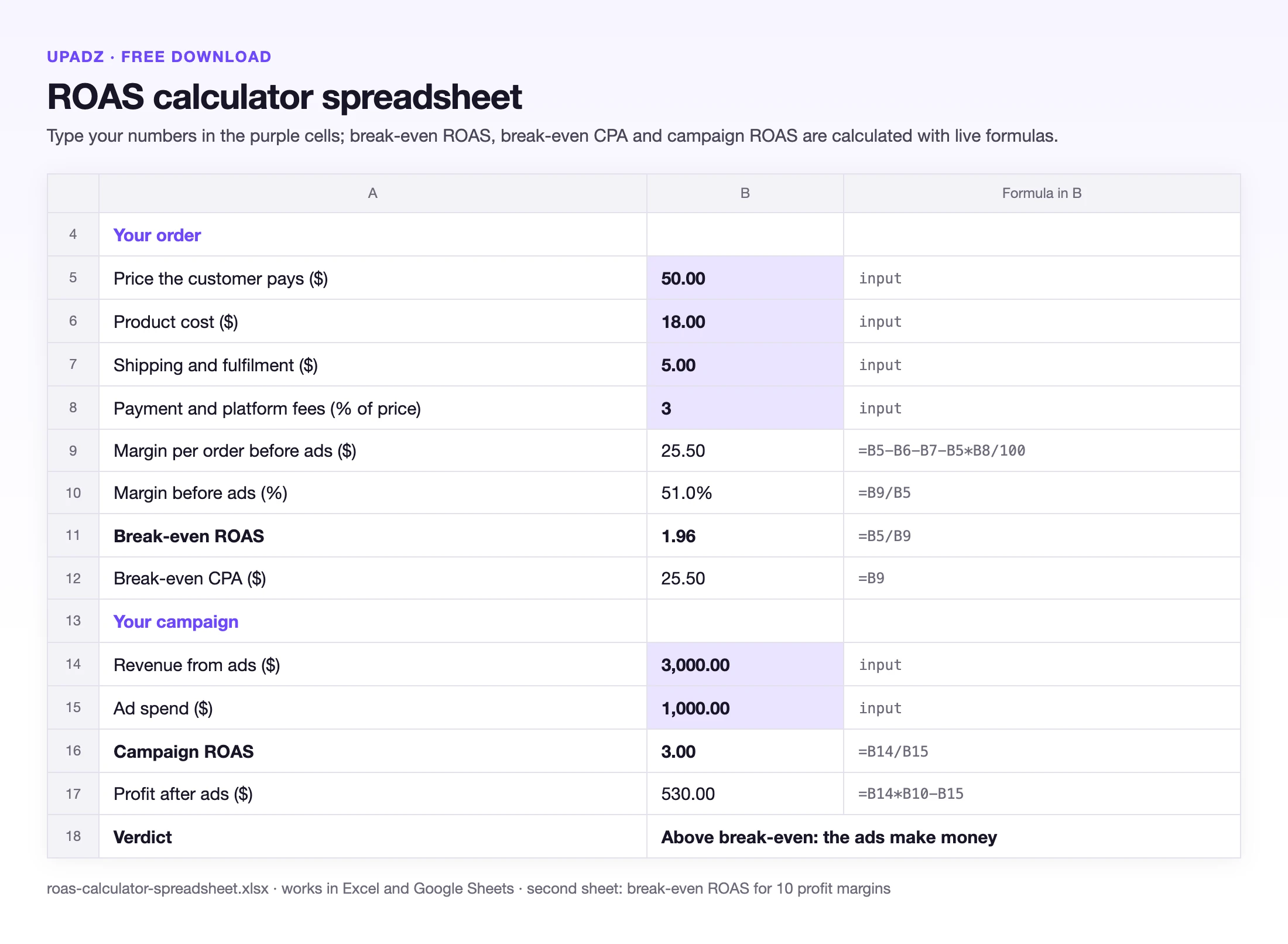
Worked example: you sell an order for $50. The product costs you $18, shipping $5, and payment fees are 3% of the price, so $1.50. You keep $25.50, a margin of 51%. Break-even ROAS is 50 ÷ 25.50 = 1.96. At a ROAS of 1.96 you spend $25.50 on ads to make the $50 sale and end with nothing; at 3.0 you spend $16.67 and keep $8.83.
Is your ROAS good? Compare it with break-even
A ROAS is good when it is above your own break-even ROAS: 3.0 is a healthy profit with a 60% margin and a loss with a 25% margin. Our guide to what a good ROAS is compares break-even with the 2026 median ROAS by industry.
A good break-even ROAS is a low one: it means a high margin, so more of each sale is profit and there is room to test new ads. If yours is above 3 or 4, work on the margin as well as the campaigns.
Break-even ROAS for dropshipping and ecommerce
Dropshipping and many ecommerce stores run on thinner margins, so their break-even ROAS is higher. Example: you sell a product for $30, it costs you $12 from the supplier, shipping is $4 and payment fees are 3% ($0.90). You keep $13.10 per order, a 44% margin, so your break-even ROAS is 30 ÷ 13.10 = 2.29 and your break-even CPA is $13.10.
The calculation is the same for Facebook and Instagram ads, Google Ads, TikTok or Shopify stores: only your price and costs per order change. Calculate it per product, because a store-wide average hides products that lose money on every ad-driven sale.
Break-even CPA: the most you can pay per order
CPA (cost per acquisition) is ad spend divided by the number of orders. Your break-even CPA is what you keep from one order before ads: in the $50 example above, $25.50. Pay less than that per order and each sale is profitable; pay more and each sale loses money.
Break-even ROAS and break-even CPA describe the same point from two sides. Ad platforms often optimize for one or the other, so this ROAS calculator also works as a CPA calculator: use the CPA as a cost cap, and the ROAS as a target in value-based bidding.
ROAS vs ROI
ROAS compares revenue with ad spend. ROI compares profit with the cost: ROI = (profit after ads ÷ ad spend) × 100. With a 51% margin, a ROAS of 3.0 on $1,000 of ads leaves about $530 of profit after ads, an ROI of 53%.
Break-even is an ROI of 0%, not 100%. An ROI of 100% means the ads doubled the money spent on them after all costs. A ROAS of 1.0 only means revenue equals ad spend, which is a loss for any product that costs something to make and deliver.
What to leave out, and what not to forget
Include every cost that rises with each order: the product, packaging, shipping, payment and marketplace fees, and returns if they are frequent. Leave out fixed costs such as rent, salaries and software; they do not change when one more order comes in.
Two things move the result more than people expect. Returns and refunds lower the real price you keep. Repeat purchases raise it: if a customer orders again without a new ad, you can afford to acquire them below break-even on the first order.
How to get above break-even
There are only three levers. Raise what you keep per order, through price, bundles or lower product cost. Raise the conversion rate of the page the ad lands on. Or lower the cost of the click, which on paid social is mostly decided by the creative: the same budget buys more attention with an ad people stop for.
Creative is usually the fastest of the three to test, because a new ad can go live today while a new price or a new supplier takes weeks.
The ROAS calculator and spreadsheet in use
Keep reading
Frequently asked questions
How do you calculate ROAS?
Divide the revenue from your ads by your ad spend. $3,000 of sales from $1,000 of ads is a ROAS of 3.0, also written 3:1 or 300%.
What is break-even ROAS?
Break-even ROAS is the ROAS at which the profit from your sales exactly pays for the ads. It equals 1 divided by your profit margin before ads: 2.0 with a 50% margin.
How do you calculate break-even ROAS?
Divide your selling price by what you keep from the order before ads: price ÷ (price − product cost − shipping − fees). For a $50 order where you keep $25, break-even ROAS is 2.0.
What is a good break-even ROAS?
The lower the better, because a low break-even ROAS means a high margin. Below 2 leaves room to test and scale; above 4 leaves little room for ads to make money.
How do you calculate break-even ROAS for dropshipping?
Use the same formula with your supplier cost, shipping and fees: a $30 product that costs $12 plus $4 shipping and 3% fees keeps $13.10, so it breaks even at a ROAS of 2.29.
How do you calculate ROAS in Meta ads and Google Ads?
Look at Purchase ROAS in Meta Ads Manager, and at Conv. value / cost in Google Ads if your conversion values are sales. Compare that number with your break-even ROAS to see whether the campaign makes money.
Is ROAS a percentage?
ROAS is a ratio, usually written as 3.0 or 3:1. Multiply it by 100 to get the percentage: a ROAS of 3.0 is 300%.
Can ROAS be negative?
No. ROAS is at least zero, because revenue and ad spend cannot be negative. Your profit after ads can be negative, when the ROAS is below your break-even ROAS.
What is the difference between break-even ROAS and break-even CPA?
They describe the same point from two sides. Break-even ROAS is revenue per dollar of ad spend; break-even CPA is the most you can spend to win one order, which equals what you keep from that order before ads.
Is ROAS the same as ROI?
No. ROAS divides revenue by ad spend; ROI divides the profit after all costs by the cost. Break-even is an ROI of 0% but a ROAS equal to your break-even ROAS.
Is there a ROAS calculator spreadsheet?
Yes. Download the free ROAS calculator spreadsheet above: type your price, costs, revenue and ad spend in the purple cells and it calculates break-even ROAS, break-even CPA, campaign ROAS and profit after ads, in Excel or Google Sheets.
Should I include fixed costs like salaries?
No. Break-even ROAS uses only the costs that rise with each order: product, shipping and fees. Fixed costs are covered by the profit you make above break-even.
More free tools
Creative is the fastest lever
Upadz turns a product page into video and static ads with different hooks to test.
Start free