
How to Scale Facebook Ads: What Meta's Own Rules Say
Most advice on how to scale Facebook ads repeats the same budget rule, “raise it 20% every few days”, without a Meta source. This guide sticks to what Meta's Business Help Center actually documents: which edits restart the learning phase, how Advantage+ campaign budget behaves, and why Meta now asks for more distinct ads rather than more ad sets. Where a popular rule is agency practice, we say so.
Updated
The short answer
To scale Facebook ads, wait until the ad set has left the learning phase, then raise the budget of what works in one clear step and leave it alone for a week. Next, widen the audience and placements, and keep adding new ad concepts that differ from each other. Meta says budget changes may or may not restart learning depending on their size.
Meta's example: going from $100 to $101 a day is not likely to restart learning; going from $100 to $1,000 may. Meta publishes no safe percentage. The “20% at a time” rule is a habit agencies use, not a Meta rule.
How to scale Facebook ads in 5 steps
Check the ad set is out of learning
The Delivery column must read Active, not Learning or Learning limited. Meta says an ad set usually leaves learning after about 50 results in the week after its last significant edit, and that results during learning don't predict later performance.
Know the ROAS you can afford
Before you spend more, work out your break-even ROAS from your margin. Scaling usually costs some efficiency, so you need to know how much room you have. The ROAS calculator does it in a minute.
Raise the budget once, then wait
Pick the new daily budget, change it in one edit and give it about a week. Meta warns that frequent budget changes can send an ad set back into learning, so five small raises in five days are not the safe option they look like.
Widen before you split
Give the system more room rather than more ad sets: a broader audience, more placements, similar ad sets combined. Meta's advice for high costs is to expand the audience and add placements, not to narrow them.
Add new ad concepts every week
Meta recommends launching new ads regularly, at least 20 diversified ads in its automated sales campaigns, and 20–30% of the budget on testing new ones. New concepts, not small variations of the same one.
Scaling decision table: the signal you see, what to change
| Criteria | What to change | Meta source |
|---|---|---|
| Delivery reads “Learning” | Don't edit or scale yet. Wait for about 50 results in the week after the last significant edit; results in this period aren't a verdict. | About the learning phase |
| Delivery reads “Learning limited” | Fix the setup before adding budget: combine similar ad sets, expand the audience, raise a budget or bid that is too low, or optimise for a more frequent event. | About learning limited |
| Stable results, cost per result on target | Scale vertically: raise the budget in one step. A large jump (Meta's example: $100 to $1,000) may restart learning; a tiny one won't. | Significant edits and learning phase |
| Cost per result rising after the ad set left learning | Expand the audience, add placements and improve the creative. Meta says relevant ads are subsidised in the auction. | Troubleshoot: your costs are too high |
| Frequency rising while results fall | The audience may have ad fatigue: change the creative or the targeting. | Frequency |
| Delivery reads “Creative fatigue” | Add a different image or video: duplicate the ad and replace the creative in the copy. | Account insights (creative fatigue) |
| Several of your ads look alike | Meta groups ads that share visual and thematic traits and treats them as one creative. Make new ads that differ in concept, visual or format. | Account insights (creative similarity); Demystifying creative diversification |
| Your own ad sets target the same people | Only your highest-value ad enters each auction, so overlapping ad sets limit each other. Combine them. | Understand auction overlap |
| Spend on one day is far above the daily budget | Normal: Meta may spend up to 75% above or below the daily budget on a given day, and with a campaign budget some ad sets get less than others. | Troubleshoot ad delivery: your campaign slowed down or stopped |
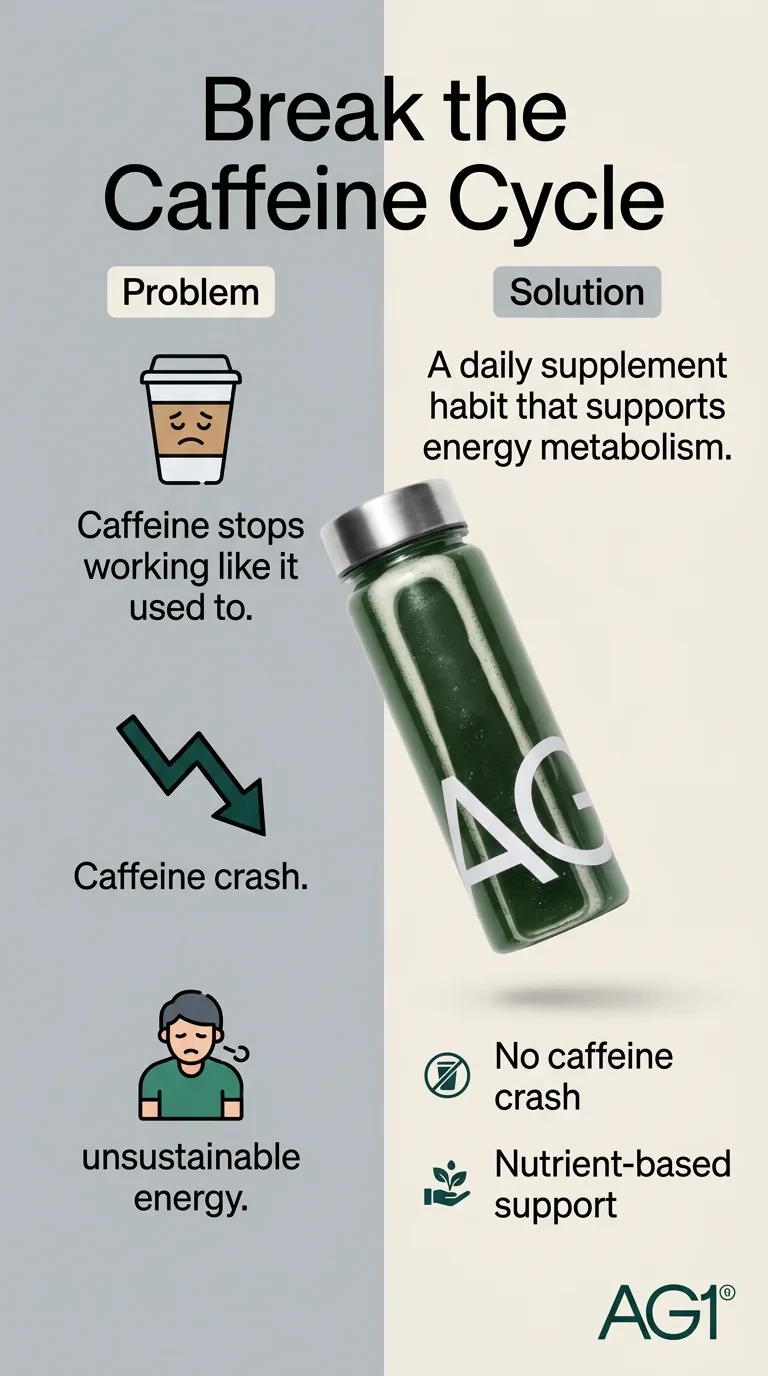
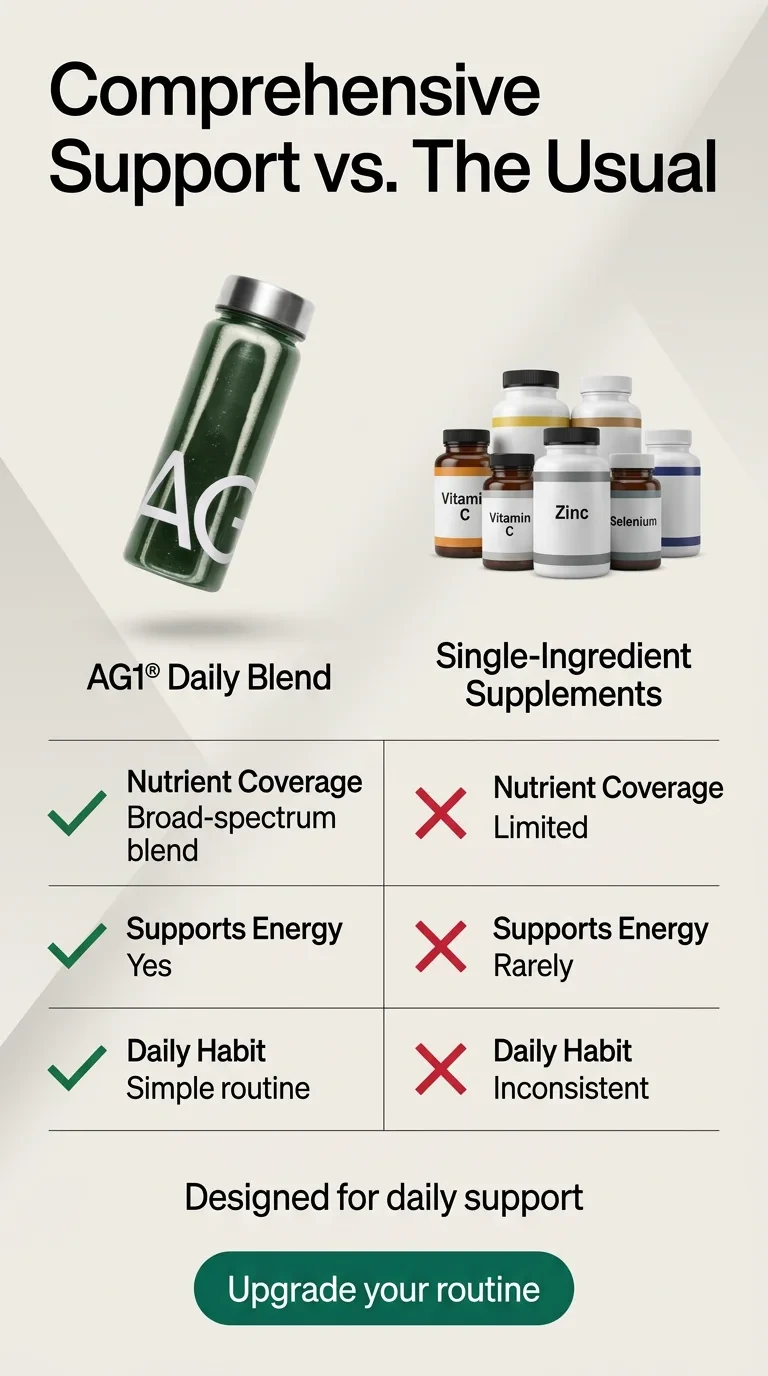
Scaling Facebook ads with new concepts: 4 ads for one product, made with Upadz
Real Upadz outputs for a daily greens drink, made from the product's own page; none is an ad the brand ran. Each one leads with a different reason to buy. Meta's system treats ads that look alike as one creative, so four concepts like these give it more to work with than four colour variations of the same ad.


When is an ad set ready to scale?
An ad set is ready to scale when it has left the learning phase and its cost per result has been on target for several days in a row. Meta says ad sets usually exit learning after about 50 results in the week after their last significant edit, and that performance during learning is less stable and usually more expensive.
Two checks before you raise anything: the Last significant edit column in Ads Manager (add it under Columns if you don't see it), and your break-even ROAS. If the ad set is barely profitable today, more budget will rarely make it more profitable; find a better ad first.
Vertical scaling: raising the budget without resetting learning
Vertical scaling means giving more budget to an ad set or campaign that already works. Meta's page on significant edits says a budget change “may or may not” send an ad set back into learning, “depending on the magnitude of the change”. Its only example: $100 to $101 is not likely to; $100 to $1,000 may.
Meta gives no percentage. The rules you read elsewhere, 10–15% at a time, 20% every three days, are what agencies do to keep each change small, not something Meta publishes. What Meta does say: avoid frequent budget changes, and a budget edit takes about 15 minutes to apply. If you also change a bid, wait 15 minutes after the budget change.
Edits that always restart learning, whatever their size: any change to targeting, to the ad creative or to the optimisation event, adding a new ad, changing the bid strategy, and pausing an ad set for seven days or more.
Horizontal scaling: more people, placements and ad sets
Horizontal scaling means reaching more people rather than spending more on the same ad set: a broader audience, more placements, new countries, or a new ad set aimed at a different group. Meta's advice when costs climb is to expand the audience and add placements, because the system looks for the cheapest results first and narrowing it removes options.
Every new ad set starts its own learning phase, including a duplicate of a winning one. Duplicates aimed at the same people also enter the same auctions, where Meta lets only your highest-value ad compete. So duplicate only to reach a genuinely different audience, and combine ad sets that overlap.
Scaling with Advantage+ campaign budget
With Advantage+ campaign budget (formerly campaign budget optimization), you set one budget for the campaign and Meta moves it between ad sets. Meta states that this redistribution does not restart learning, that adding a new ad set does not restart the others, and that an edit made inside one ad set affects only that ad set.
The catch is the campaign level: raising the campaign budget or switching the campaign bid strategy may send several ad sets back into learning at once. Make those changes less often and in one step. Judge the campaign on its total results and average cost, not on how the budget was split; Meta says it is normal for some ad sets to receive less.
Scaling Facebook ads with new creatives
On Meta today, a large part of scaling Facebook ads is creative volume. Meta's November 2024 guidance for its automated sales campaigns is to launch new ads every week, keep at least 20 diversified ads live and spend 20–30% of the budget testing new ones. Its sales campaign best practices also ask for “a wide variety of diverse creative assets”.
Diversified is the key word. In December 2025 Meta explained that its ads system groups ads that share key visual and thematic attributes and treats them as variations of one creative, with learnings shared between them. Andromeda, its retrieval model, then picks a few thousand candidates from tens of millions of ads for each person, so distinct ads give it more to choose from. A new headline on the same image is iteration; an ad with a different angle, visual or format for a different buyer is diversification. You need both, but only the second gives the system new people to find.
Note that adding an ad to an ad set is a significant edit and restarts its learning. Add new ads in batches, for example once a week, rather than one a day.
Scaling myths vs what Meta documents
“Never raise the budget more than 20%.” No Meta page sets a percentage. Meta says the effect depends on the size of the change, with $100 to $101 and $100 to $1,000 as examples. Small steps are a sensible habit, not a rule.
“Small daily raises are safer than one bigger raise.” Meta warns that frequent budget changes can send an ad set back into learning. One clear change, then a week of patience, matches its guidance better.
“Duplicate the winner to scale it.” A duplicate is a new ad set with its own learning phase, and if it targets the same people it competes in the same auctions as the original.
“More ad sets mean more reach.” Meta recommends fewer, combined ad sets: many ad sets in learning at once each get fewer chances to deliver.
“More ads is always better.” Meta asks for more distinct ads, not more copies. Ads that look alike are grouped as one creative, and Meta warns against high ad volumes that split learning.
Before you scale a Facebook campaign
- Ad set out of learning, cost per result stable for several days
- Break-even ROAS known
- One budget change planned, not a daily series
- Overlapping ad sets combined
- Audience and placements as broad as the product allows
- New ad concepts ready to add in one batch
Make the new ad concepts with Upadz
When scaling means feeding Meta new concepts every week, making them is the bottleneck. Upadz researches the buyer and the ads running in your market, then proposes 3 ad concepts per product, each with its own angle and hook, and turns the one you pick into a finished video ad (50 credits (720p) or 75 credits (1080p)) or static ads (6 credits (Faster) or 10 credits (Pro) per image). The four greens drink ads above are Upadz static ads: four reasons to buy the same product, which is what Meta means by diversified.
Keep reading
Frequently asked questions
How much should I increase my Facebook ad budget at a time?
Meta gives no percentage. It says a budget change may or may not restart learning depending on its size: $100 to $101 is not likely to, $100 to $1,000 may. Many agencies raise 10–20% at a time; that is their practice, not a Meta rule.
Does increasing the budget reset the learning phase?
Sometimes. Budget is one of the edits Meta says may or may not be significant, depending on the size of the change. With Advantage+ campaign budget, a campaign budget change may send several ad sets back into learning.
What is the difference between vertical and horizontal scaling?
Vertical scaling gives more budget to what already works. Horizontal scaling reaches more people: broader audiences, more placements, new countries or new ad sets for different groups.
Should I duplicate a winning ad set to scale it?
Only to reach a different audience. A duplicate starts its own learning phase, and if it targets the same people it competes in the same auctions as the original.
How many creatives do I need to scale on Meta?
For its automated sales campaigns, Meta recommends at least 20 diversified ads, new ads every week, and 20–30% of the budget on testing new ones. Ads must differ in concept, since Meta groups look-alike ads as one creative.
Why did my results drop when I scaled?
Usually one of three things: the change restarted learning, the audience is seeing the same ads too often (rising frequency, Creative fatigue status), or your own ad sets overlap. The decision table above maps each signal to Meta's fix.
Facts checked on against Meta Business Help Center: About the learning phase, Meta Business Help Center: Significant edits and learning phase, Meta Business Help Center: Change your budget in Meta Ads Manager, Meta Business Help Center: Troubleshoot ad delivery: your campaign slowed down or stopped, Meta Business Help Center: Troubleshoot ad performance: your costs are too high, Meta Business Help Center: About learning limited, Meta Business Help Center: Understand auction overlap, Meta Business Help Center: Frequency, Meta Business Help Center: About Account insights (creative fatigue and similarity), Meta Business Help Center: About Advantage+ sales campaigns, Meta for Business (2024-11-19): Three steps to optimize your performance with creative diversification, Meta for Business (2025-12-16): Demystifying creative diversification. Prices and features change; tell us if something is out of date.
Get new ad concepts to scale with
Get 3 ad concepts for your product, each with a different angle, ready to add to your next batch.
Start free